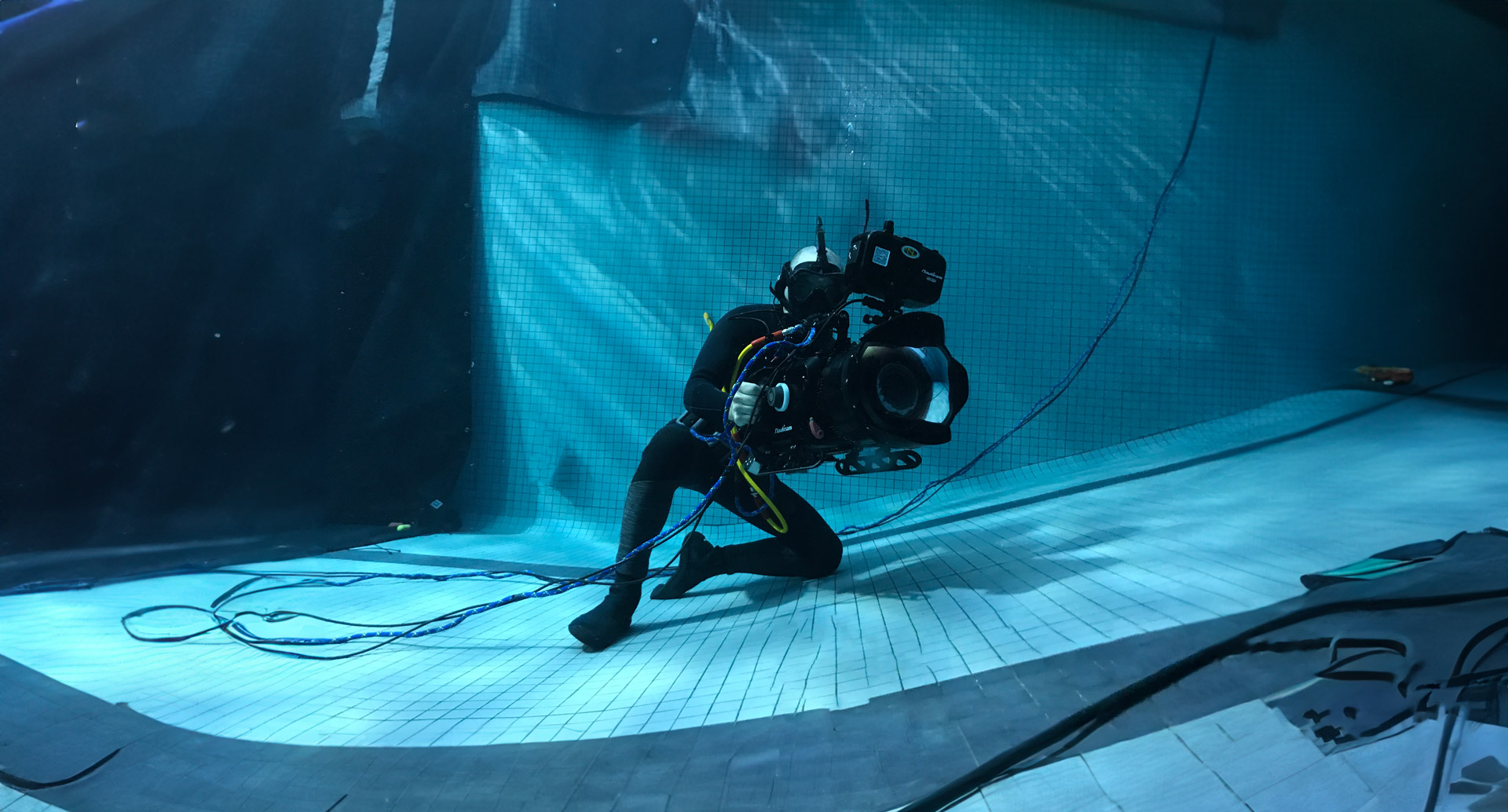

Filming underwater is one of the most technically challenging environments in cinematography. The moment a camera enters the water, the physics that shape the image change dramatically.
Light bends, colors disappear, pressure increases, and movement becomes slower due to water resistance. These forces influence everything from how a scene looks on camera to what lenses filmmakers should use.
Understanding the physics behind underwater filming allows cinematographers to adapt their gear and capture clearer, more cinematic footage beneath the surface.
Refraction: Why Underwater Images Look Different
One of the most noticeable physical effects underwater is refraction.
Refraction occurs when light travels between two mediums with different densities. When light moves from air into water, it bends because water is denser.
This bending alters how objects appear on camera:
– Subjects appear closer than they actually are
– The field of view becomes narrower
– Straight lines may appear slightly distorted
Underwater housings often use dome ports to correct these distortions. Dome ports restore the natural field of view of wide lenses and help preserve image quality.
Flat ports, on the other hand, magnify the image slightly and are often used for macro photography.
Color Absorption: Why Reds Disappear
Water absorbs different wavelengths of light at different depths.
The deeper a camera goes, the more colors are lost.
The order of color loss generally follows this pattern:
– Red disappears first
– Orange and yellow fade next
– Green and blue travel the farthest
This is why underwater footage often appears overwhelmingly blue or green.
To compensate, underwater cinematographers use artificial lights, red filters, and manual white balance adjustments to restore the colors that water naturally removes.
Pressure: The Deeper You Go, The Stronger It Gets
Pressure increases rapidly underwater. For every 10 meters (33 feet) of depth, the surrounding pressure increases by roughly one additional atmosphere.
Underwater camera housings must be built to withstand these forces without leaking or deforming. Professional housings are typically made from aluminum or reinforced materials and sealed using O-rings.
Even the smallest seal failure can allow water to enter and damage camera equipment.
Drag: Why Underwater Movement Feels Slow
Water is far denser than air. Because of this, any object moving through water experiences much greater resistance, known as drag.
For filmmakers, this affects how cameras move through the water.
Large camera rigs experience greater drag, which makes fast movements difficult. Instead, underwater shots often appear smooth and slow, creating fluid and controlled motion.
Visibility and Particle Scattering
Unlike air, water is filled with particles such as sand, plankton, and organic matter.
When light hits these particles, it scatters. This scattering can cause a visual effect called backscatter, where particles appear as bright floating specks in footage.
To reduce backscatter, underwater cinematographers typically place their lights at an angle rather than directly beside the camera lens.
The Physics Behind Choosing the Right Lens Underwater
Lens selection underwater isn’t just a creative choice — it’s largely dictated by physics.
Water reduces contrast, clarity, and color over distance. The farther a subject is from the camera, the more water interferes with the image.
This is why underwater filmmakers rely heavily on wide-angle lenses. Wide lenses allow the camera to get physically closer to the subject while still capturing a large environment, reducing the amount of water between the camera and the subject.
Wide-Angle Lenses
Wide lenses are ideal for filming coral reefs, shipwrecks, divers, large marine animals, and underwater environments.
These lenses are often paired with dome ports, which help maintain their wide field of view by correcting the refraction caused by water.
Fisheye Lenses
Fisheye lenses are even wider than traditional wide-angle lenses and create an extremely large field of view with a curved perspective.
Underwater cinematographers use fisheye lenses when they want to capture dramatic environments while staying extremely close to the subject, minimizing the amount of water between the lens and the subject.
Macro Lenses
Macro lenses are used for filming small marine life and detailed textures.
These lenses work well with flat ports, which slightly magnify the image and help capture fine details. However, macro filming requires precise focus and careful lighting because the depth of field becomes extremely shallow.
Why Telephoto Lenses Rarely Work Underwater
Telephoto lenses are useful on land when subjects are far away, but underwater they are rarely practical.
Because water reduces clarity and contrast quickly, filming from far away results in hazy footage filled with particles and color loss.
For this reason, underwater cinematographers usually follow one simple principle: get close to the subject.
Where Science Meets Cinematography
Underwater filmmaking sits at the intersection of physics and visual storytelling.
Every shot is shaped by the environment: light bending through water, colors disappearing with depth, pressure affecting equipment, water resistance shaping camera movement, and lens choices compensating for optical changes.
By understanding these physical principles, filmmakers can adapt their techniques and equipment to capture the stunning visuals hidden beneath the surface.