
Blog

Beyond Boundaries: ToughSignal’s Role in Redefining Filmmaking Challenges

In the dynamic landscape of filmmaking, connectivity and communication stand as critical pillars for success — especially in remote locations.

Enter ToughSignal, a powerful solution for remote internet needs, designed to strengthen and protect your film productions.

In this article, we will delve into the key features of ToughSignal, explore how this technology benefits filmmakers, and how it has revolutionized remote internet connectivity for challenging environments, particularly the underwater sphere.


About ToughSignal

ToughSignal is your go-to for powerful remote internet. It’s resilient, easy to use, and
scales to your filmmaking needs

Key Features:

  1. Reliability: ToughSignal keeps you connected anywhere. It combines up to 5 internet sources through network bonding technology for extreme reliability and security.
  2. Straightforward Operation: ToughSignal has a user-friendly design with an integrated power button inside the case. Once you connect to the dedicated Wi-Fi network, you can start working.
  3. Battery Life: With a massive 54,000 mAh battery, ToughSignal provides up to 72 hours of runtime on a single charge.

Business Use Cases:

  1. Live Streaming: ToughSignal provides stable and uninterrupted internet connection for live streaming, festivals, or trade shows.
  2. Mobile Teams: ToughSignal is ideal for teams on the move. Smooth video calls, quick data transfer, and secure access to your files.
  3. Education & Health: Uninterrupted internet for online classes, virtual labs, or remote health services.

ToughSignal emphasizes its commitment to customer relationships and technical expertise under pressure through ToughCare™ Priority Support, staffed by enterprise-class network engineers.


How ToughSignal Benefits Filmmakers

ToughSignal enhances connectivity and communication in the film industry in three main areas:

Cell Service

ToughSignal has multiple high powered antennas that reach cell towers a phone cannot. If you’re on a film shoot where cell service isn’t reliable but you still need access to Wi-Fi and phone calls, ToughSignal acts as a hotspot for everyone on set.

Remote Locations

If you find that no one has service during a location scout, you can fix that problem
ahead of time. Using ToughSignal is a great safety backup that streamlines
production and makes you feel like you’re back in the studio.

ToughSignal (with the Starlink add on) connects you to the internet in any remote location as long as you have a clear view of the sky. The Starlink antenna provides access to the Starlink satellites so you’re not tethered to cell towers. When Starlink is in use, ToughSignal acts as a modem.

Large Events

If you attend an event that has good service but a large crowd takes up a substantial amount of bandwidth from neighboring cell towers, you can use ToughSignal to bypass the cell towers nearby. It will connect you with further cell towers that are less jammed up.


How ToughSignal Provides Solutions for ASL Clients

With over 30 years of experience, we understand the challenges that come along with filmmaking. Our unwavering commitment to simplifying our clients’ lives propels us to explore cutting-edge solutions. After an extensive search, we’re thrilled to unveil a product that not only meets but exceeds expectations, delivering truly remarkable solutions:

Safety

Since we work in unconventional environments, safety is always our top priority. In the past, we’ve run into a problem: no cell service on the boat in the middle of the ocean. Although our expert camera operators and technicians are trained to handle uncertain situations, it’s important to be able to contact emergency services if needed. ToughSignal enhances any communication you may need. If something
goes wrong, you’re no longer on your own.

Remarkable Access

ToughSignal gives you access to remote locations like never before. Since underwater live streaming comes with many challenges, it has only ever been done three times – all by us. With this technology, the possibilities to do livestreams in any capacity (through live TV or an app like Zoom, Facebook, or Instagram) are endless. Whether you stumble upon a pride of lions on a safari or start swimming with sharks off the coast, a live presenter can narrate for your audience, bringing them right into
the action.

Cost Effective and Effortless Live Streaming

In our initial endeavor into live underwater feeds, we arranged microwave transmitters aboard a boat to send signals to a strategically positioned satellite truck on the shore. This truck beamed the signal up to a satellite, serving as our uplink. While this intricate setup thrived in proximity to the shore, it would not serve us for our next live event 80 miles off shore. Instead, we needed to place large satellites on
the boat itself, requiring a larger boat to fulfill the task.

With ToughSignal, everything you need to live stream is self contained within two
cases. Not only does this reduce the possibility of error or failure, it dramatically
reduces the costs associated with live productions of the past.


ToughSignal is Your Go-To Solution

From enhancing communication in remote locations to providing a safety net in unconventional filming environments, ToughSignal transforms what was once near impossible into endless filmmaking possibilities.

With a unique set of features, ToughSignal provides bold filmmakers the security they
need to pursue their creative vision.

ASL clients, supported with over 30 years of filmmaking expertise, now have at their
disposal a tool that not only simplifies but revolutionizes their productions.


To explore ToughSignal further, check out our web page or contact our team for more
information via:

Website: airsealand.com
Telephone: +1 (718) 626.2646
Email: info@airsealand.com or rentals@airsealand.com


Underwater Communication: Crucial Steps We Take To Succeed

In the enchanting world of underwater filmmaking, the significance of communication
takes center stage. With over 30 years of industry experience, we appreciate that
effective communication is not only desirable but indispensable in underwater
cinematography. This blog post dives deep into the ways underwater camera operators
communicate to show you what goes on below the surface.


The Importance of Communication on Set

Regular communication on a film set is not only normal, but necessary. The following
areas are some of the reasons why effective communication is so important:

  • Collaborations: There are numerous professionals involved in filmmaking: talent, camera operators, directors, and producers to name a few. Each department must coordinate and align to achieve the goals of production.
  • Adjustments: Whether it is due to lighting, weather, or problems on set, there are many on-the-fly adjustments made during production. This necessitates updates to all professionals involved.
  • Direction: One of the camera operator’s role in underwater filmmaking involves translating the director’s vision into achievable actions for talent.
  • Problem-Solving: The camera operator employs hand signals to relay information to the above-water camera technician, facilitating the swift transmission of underwater conditions to the entire crew.
  • Safety and Logistics: Filming underwater can become hazardous if there are no experts around to help. Communication throughout production helps maintain safety and ensure everyone is on the same page before shooting.

Unique Ways to Communicate Underwater

There are many challenges that filmmakers face when communicating underwater.
Since they cannot talk to each other naturally, they have to figure out ways to convey
what they need. Below are some ways they do this:

Underwater PA System

We use a Hydrophone to communicate to everyone underwater at once. It is an ideal system for a pool when the topside Director needs to communicate one-way to the underwater camera operator and/or talent during a shoot. The Hydrophone is calibrated for the sound waves to travel through water rather than air. When the director speaks into the microphone, anyone in the pool can hear what they are saying.

Setting up a PA system is quick, enhances communication, ensures clear directives for talent, streamlines production flow, and reduces time spent underwater.

Communication System

A communication system, like the OTS Aquacom MK2-DC1, is ideal for underwater talent communications in a live broadcast situation. Up to four divers can communicate to a topside tender via a four wire mask system with ComRope. This system is beneficial if for longer underwater productions or if you want to make many changes to your shots. The camera operator can speak directly to the talent underwater and to the topside director and camera technician.

Hand Signals

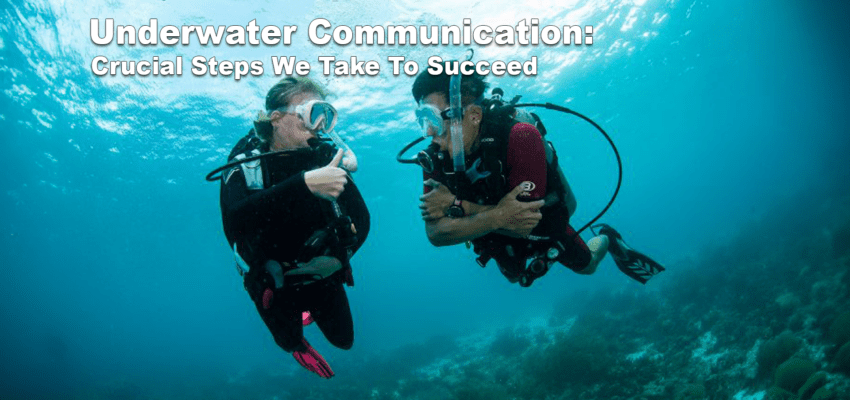
Since a PA system only works one-way, from topside to underwater, hand signals are used between the underwater operator and the topside technician. The operator can alert the technician quickly and efficiently if they are ready to shoot or if they need production to wait.


The Professional Association of Diving Instructors has a standardized set of hand signals that we utilize. The ones we use most often are:

  • Ascend, which is a thumbs up.
  • Descend, which is a thumbs down.
  • Are you OK?/I am OK which is a circle made with your thumb and forefinger with all remaining fingers extended upward.

The operator will inform talent what the signals mean and what to do if they see them.
This helps keep everyone safe and on the same page.


The Consequences of Miscommunication

If underwater communication systems are not set up, you can run into a number of issues. If talent cannot hear direction, they cannot adjust on the fly. If the operator cannot hear direction, they might:

  • start rolling too early
  • stop rolling before the director calls cut
  • continue rolling when everyone else has cut
  • frame a different shot than what the director wants

All of these issues add time to production.


Pre-Production Planning

Preparing for effective communication happens long before you arrive to set. When you hire an expert, we help you decide which type of communication system will work best for your situation.


Having the right equipment and expertise contributes to effective communication on set. If you’re shooting in a pool, we recommend using a PA system. If you’re shooting in open water, using comms and hand signals become even more important.

When we’re on set, we establish ground rules of how to communicate using the systems so everyone has context for the framework we work within. This ensures everyone is informed about upcoming actions, eliminating guesswork and reducing on-set confusion and time.


Diving In?

In the world of underwater filmmaking, clear communication goes a long way. From PA systems to communication devices, these innovations enhance clarity and streamline production, while minimizing costly delays and misaligned shots.

Comprehensive pre-production planning can help you choose the right communication system and establish clear communication protocols to ensure your underwater shoot goes off without a hitch.


With over three decades of industry experience, we’re happy to help with your next
underwater adventure. You can contact our team for more information via:

Website: airsealand.com
Telephone: +1 (718) 626.2646
Email: info@airsealand.com or rentals@airsealand.com


The Importance of Having a Camera Check-Out Day Before Your Shoot

With 30 years of experience, we understand that filmmaking can be challenging. Shooting underwater? Now that’s an entirely different story. There are many challenges involved in this specialized form of filmmaking.

Achieving success on set isn’t solely about the shoot day itself; it’s about meticulous planning during pre-production as well. This post explores the crucial role of a camera check-out day in underwater shoots and provides insights into the behind-the-scenes process.


Camera Check-Out Day

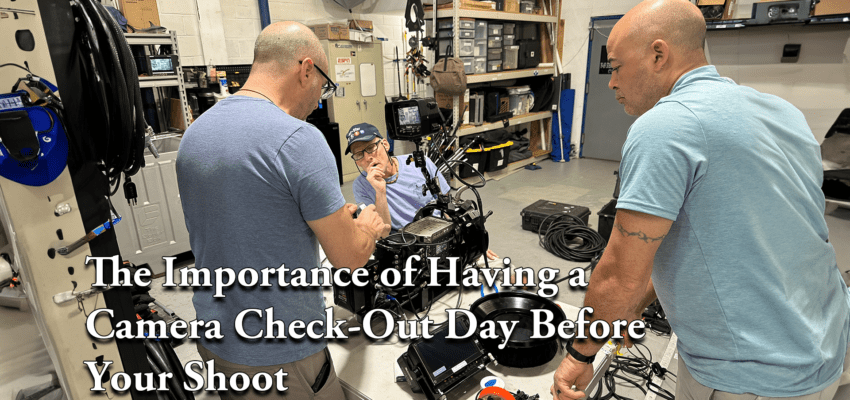
A camera check-out day prepares your camera and underwater housing for shooting a day before it’s needed. It’s important to make sure that the lenses fit within the housing, the gears line up on your lenses, and that you have full control over focus, iris, and zoom. We also make sure the housing does not obstruct the camera’s view and create vignetting around the edges of the shot


The Benefits of Having a Check-Out Day

Having a camera check-out day reduces downtime, minimizes technical issues on shoot day, and ensures optimal performance underwater.

  • Time: Assembling the camera and housing typically takes up to 1.5 to 2 hours. Having a check-out day means the camera is ready to go as soon as it arrives on set. No time is wasted.
  • Troubleshooting: Since Air Sea Land is the largest rental house for professional underwater camera gear in the North East, we have everything you need to address potential problems before you get to set. If there are issues getting the camera and lens package into the housing on check-out day, we have time to change lenses and make the necessary adjustments to ensure a successful shoot.
  • Performance: Once we confirm the seals are water tight, we balance the housing in our tank to ensure it is neutrally buoyant. This means the housing stays put in the water; it is the best case scenario for the operator and crucial if you want to get the best shots possible.

Beyond the advantages of minimizing downtime and technical glitches, a check-out day offers a unique opportunity for those last-minute adjustments that can make a world of difference. It’s the peace of mind that comes from knowing that your equipment has been rigorously checked and the confidence gained knowing your camera is ready to go.


The Disadvantages of Forgoing a Check-Out Day

Choosing not to have a check-out day can result in a number of issues while on set.

  • Buoyancy: If the housing is not neutrally buoyant, it will either sink or float. If it is buoyant, the operator will have to pull the housing down for the duration of the shoot. If it is negatively buoyant, the operator will have to hold the housing up. If the housing rolls to either side, the operator must fight against that as well. This will affect the outcome of your shots.
  • Lens Difficulty: If the lenses you have on set do not fit in the housing, the underwater shots you want will be impossible to shoot. If the lenses fit but create a vignette in your shot, your desired outcome will be very difficult to meet.
  • Incompatible Accessories: If the focus motor does not physically fit within the housing, or you realize you need another accessory in order to make it work, there is limited time for error correction. If you need a new piece delivered to set, your production cost will go up.

When production companies skip on hiring a technician and/or operator, their production
day is typically extended or certain shots are dismissed. This is because of the
additional technical time consumed.


What To Expect on Check-Out Day
  • Duration: A typical check-out day is a half day of labor — around 4 hours maximum. Duration is subject to change depending on the housing chosen.
  • Process: An experienced camera technician builds the camera and housing, completes all necessary tests for you, and makes adjustments to the equipment based on their assessment.
  • Attendance: It is best to have an Assistant Camera (AC) present to ensure the camera settings are correct before going into the housing. When the camera enters the housing, the focus and iris markings on your lens will no longer be visible. The AC can use this time to make focus and iris marks on the controls so they are able to pull focus while on set.

If you decide against hiring one of our experienced camera technicians on your check-
out day, we will assist in answering any questions you may have about the housing.


Maintenance and Care

When housings return to our shop, and before they are rented out again, we inspect
multiple aspects of the equipment to maintain longevity. This process allows our
housings to be ready for the next filmmaker’s production.

  • Seals and O-Rings: We make sure the seals are secure and do not allow any water into the housing. We check the O-rings for any irregularities and lubricate them upon each return.
  • Pressure Tested: We pull a vacuum to make sure air does not seep into the housing.
  • Sediment: We check for sand, salt, and dirt. If our housings are not properly cleaned while on set, our camera technicians rinse and clean them thoroughly. This is an additional labor cost.

This maintenance process is a necessary step we take to provide the best possible
tools for your underwater productions.


We’re Here to Help

Our 30 years in the film and television industry have shown us that underwater filmmaking presents abundant challenges, with little margin for error. Meticulous preparation can be the difference between a shoot that flows smoothly and one that turns into a filmmaker’s nightmare.

A camera check-out day is a critical step that ensures your camera and underwater housing are in peak condition and ready for production. It minimizes downtime and technical issues on the actual shoot day.

Whether you’re a seasoned underwater operator or embarking on your first underwater shoot, we invite you to reach out to us. When you schedule a camera check-out day with Air Sea Land, our commitment to ensuring your productions go off without a hitch will shine through.

You can contact our team for more information via:

Website: airsealand.com

Telephone: +1 (718) 626.2646

Email: info@airsealand.com or rentals@airsealand.com

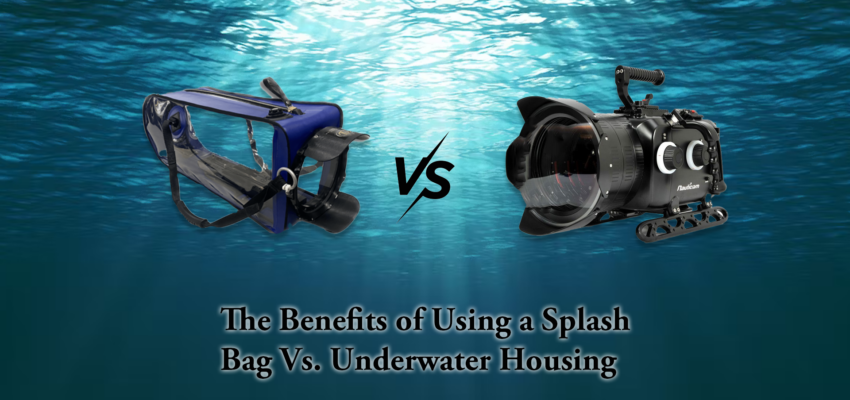
The Benefits of Using a SplashBag Vs. Underwater Housing

Choosing the right camera equipment can make or break your day on set. When you add water to the mix, you must also consider how you are going to keep the equipment safe. This post delves into the advantages of utilizing Splash Bags and Underwater Housings, the differences between them, and when to use one over the other.


Understanding Splash Bags and Underwater Housings

Since cameras are not waterproof, we need a way to keep cameras safe on set when water is involved. Splash bags are used to cover a camera when there is exposure to water and splashes on set. They are great for shots that just break the surface. Underwater housings are used when the camera must be fully submerged in the water for long periods of time. Splash bags offer temporary protection and convenience whereas underwater housings offer more comprehensive camera protection and advanced shooting capabilities.


Splash Bag Benefits and Considerations

Splash bags have certain advantages that underwater housings do not:

  • Portability: Splash bags are made of polyurethane which makes them easy to handle and transport.

  • Efficiency and Ease of Use: Once the bag is tested for leaks on set, the camera slides into the bag, gets zipped up, and is ready to shoot. If the camera needs a lens change, you take the camera out, change lenses, and put it right back in. When you are done with the water scenes, you can take the camera out and continue shooting as normal.

  • Adaptability: Splash bags are less camera specific than housings since they fit different types of cameras inside.

  1. Cost-Effectiveness: Splash bags are the less expensive option when it comes to protecting your camera from water.

While Splash Bags have many benefits, there are a few main things to consider:

  • Fragility: Since splash bags are made of polyurethane, they must be handled with care. This means avoiding concrete or hard surfaces that can puncture the bag when not in use. If there are any sharp parts of the camera, putting the camera in and taking it out should be done with care.
  • Leaks: While all of our equipment is tested in our shop prior to your production date, the bag should be tested the day of without the camera inside. The zippers should be lubricated properly and the air release valve should be closed.
  • Depth: While some splash bags can be submerged underwater, they should not be underwater all day. We always suggest and recommend a hard case housing anytime submerging more than a couple of feet.
  • Lens Control: Since there are no controls on the splash bag, camera control must be done through remote lens control.

Underwater Housing Benefits and Considerations

There are many benefits that underwater housings provide:

  • Durability: Since housings are made from aluminum, they are more durable than splash bags. You won’t have to worry about puncturing a housing.
  • Protection: Housings are more secure and cannot leak in the same way a splash bag can. They can also be underwater for longer periods of time.
  • Depth: While the ASL Splash Bags are verified for 3-4 ft max, housings can typically shoot in depths past 100 ft.
  • Lens Control: Housings are specially designed for a specific camera with lens and camera controls on the outside of the housing (not including the Hydroflex).

Below are some points to consider prior to your production date:

  • Leaks: While housings are generally more secure against leaks, the seals and O rings must be checked and tested before going into the water with the camera. Inspect for dirt or cracks and make sure the O rings are in their proper position. When closing the latches on the housings, it is best to do all of them at the same time. If that is not possible, closing them in a criss-cross fashion is best.
  • Camera Specific: With the exception of the Hydroflex, a housing is generally camera specific. For example, you cannot put a RED V-Raptor into an ARRI Alexa 35 Housing. Instead, you would need a RED V-Raptor Housing.
  • Lens Control: The operator can have full focus, iris, and zoom control on the housing itself or a remote lens control can be used topside. Since wireless signals do not transmit underwater, external lens control must be wired. With the Hydroflex housing, there are no physical camera controls on the housing and thus camera control must be done topside through a lens control system.
  • Time: The camera must be stripped of all accessories before being set up inside the housing. If you need to change lenses, you have to:
    1. Release the vacuum seal from the housing in order to open it
    2. Work around the space constraints of the housing in order to change the
      lens
    3. Set the lens control gears back up
    4. Seal the housing by pumping out the air from inside (either with the provided
      electronic vacuum or manual pump).

Since time is the biggest limitation with housing, it’s best to have an extra
camera body on set that can reside in the housing all day.


Proper Maintenance and Care

Cleaning and drying are the best ways to ensure the longevity of splash bags and underwater housings. If you are shooting in salt water, rinse the gear with fresh water when you’re done and dry it as quickly as possible. Before opening a splash bag or housing, have a towel or compressed air nearby to dry any extra water that could drip onto the camera.


The Impact of Heat

Whether your camera is sealed in a splash bag or underwater housing, the heat from the camera recirculates inside, making the camera even hotter. If you’re shooting in cool water, the water outside of the housing will pull some of the heat out. It’s important to keep the sealed housings and splash bags out of the sun. When the cameras are not in use, unseal them away from the water in a shaded area to allow the heat to dissipate, if possible.


Tailoring Solutions to Your Needs

Air Sea Land is the largest production and rental house for Professional Underwater camera gear in the North East, US. With our extensive knowledge of different models and brands, we can provide tailored options for filmmakers based on their project requirements. Whether it’s working within a certain budget or finding solutions to fit your specific case, we are happy to guide you to the best solution. You can check out our inventory here.

Our rental process can be done online or over the phone. We recommend:

  • Reading the manual of the equipment you are renting prior to booking it
  • Scheduling a check out day so we can assist you in set up and troubleshooting
  • Booking a tech who can assist you with the gear on set

If you encounter any issues with the equipment, or have general questions or concerns,
please do not hesitate to reach out!


If you’d like to learn more about the common challenges encountered in underwater shooting and practical solutions to ensure successful productions, check out our article here.

If you’re interested in the safety challenges encountered in underwater shooting and the key considerations when deciding to hire an expert, check out our article here.

Safety Precautions And Key Considerations When Shooting Underwater

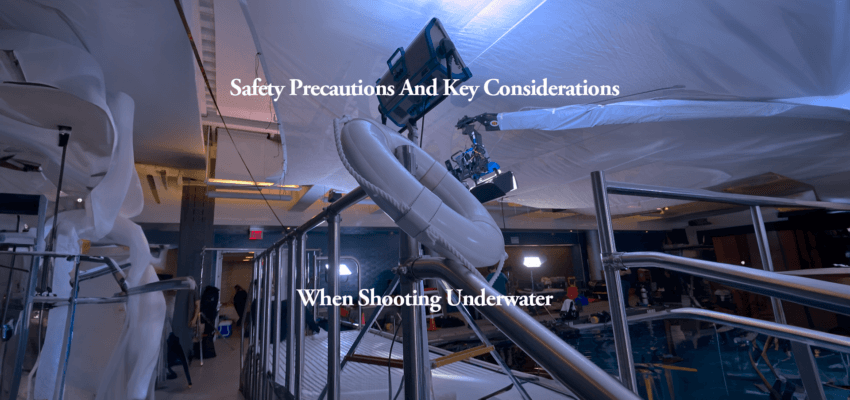
Shooting underwater may seem simple on the surface, but diving deeper uncovers the many challenges experts face in this environment. From pacing and shot list to communicating underwater and handling equipment, precautions should be taken to ensure the well-being of the cast and crew. This post explores the safety challenges encountered in underwater shooting and provides key considerations when deciding to hire an expert.


The Importance of Safety in Underwater Shooting

While there are many challenges associated with this type of shooting, safety is one of the biggest priorities of an underwater camera operator. Below are some safety considerations to keep in mind:

Pacing

Everything slows down when water is involved:

  • Normal tasks take longer to complete.
  • Direction takes longer to incorporate.
  • Shots take longer to shoot.

Preparing for this ahead of time greatly impacts a production’s success. Reducing the shot list and organizing it in an efficient manner is key.

Environment

Being immersed in a pool or open water for extensive periods of time can be dangerous. Fatigue must be considered while shooting underwater. A lifeguard is required to be on set. A safety diver accompanies the cast and crew in the water at all times. In open water, there are infinite variables to consider: bad weather, strong currents, reduced visibility, marine life, etc. Since the camera operator and safety diver understand the intricacies of the underwater environment, they are able to recognize the limits of everyone involved. They know when it’s time to stop and start again to protect the cast and crew.

Communication

The camera operator works closely with talent to fulfill the director’s needs. Breaking down direction into actions that are easier to accomplish in the water requires expertise and efficiency. Using an Underwater PA System helps with communication. This brings clarity to talent, allows for production to move at a steady pace, and reduces time spent in the water. To further streamline production, the camera operator uses hand signals to communicate with the camera technician above water. This enables the technician to quickly relay the status of the underwater environment to the rest of the crew.

Handling Equipment

Diver training and certification is required to use scuba gear for underwater shoots. If a camera operator attempts to shoot underwater without proper certifications, they are prohibited from using air from scuba tanks. They must hold their breath for extended periods of time and come to the surface after each shot. This not only slows production but also puts the cast and crew in jeopardy.

The Benefits Of Having An Expert On Set

There are many advantages of hiring experts who understand the ins and outs of shooting underwater. Among them are adaptability, efficiency, order, and trust.

Adaptability

Experts who are well acquainted with the challenges of underwater shooting are highly adaptable. While they have the foresight to know what will work before starting, they also know how to pivot if something is not going according to plan. Due to their experience, they are attuned to intricate details and can easily solve problems on set.

Efficiency

Ambition can lead to a filmmaker’s demise if they are inexperienced with the underwater environment. An overabundance of shots that are not feasible for the environment is dangerous for anyone in the water. An expert understands what shots are practical, how to prioritize and execute the shots, and how to achieve them in the least amount of time possible.

Order

When an expert is present, the chaos that arises due to a lack of prioritization,execution, and time management disappears. Procedures are in place, steps are followed, time is used efficiently, and everyone does their best work.

Trust

Experts allow productions to run smoothly and create a safe environment for the cast
and crew.

The camera operator knows how to:

  • maneuver to get the desired shot
  • Safety Precautions And Key Considerations When Shooting Underwater4make talent feel comfortable in the water
  • communicate effectively to guide the production toward success

Exploring Depths Safely and Creatively: “On Duty” Case Study

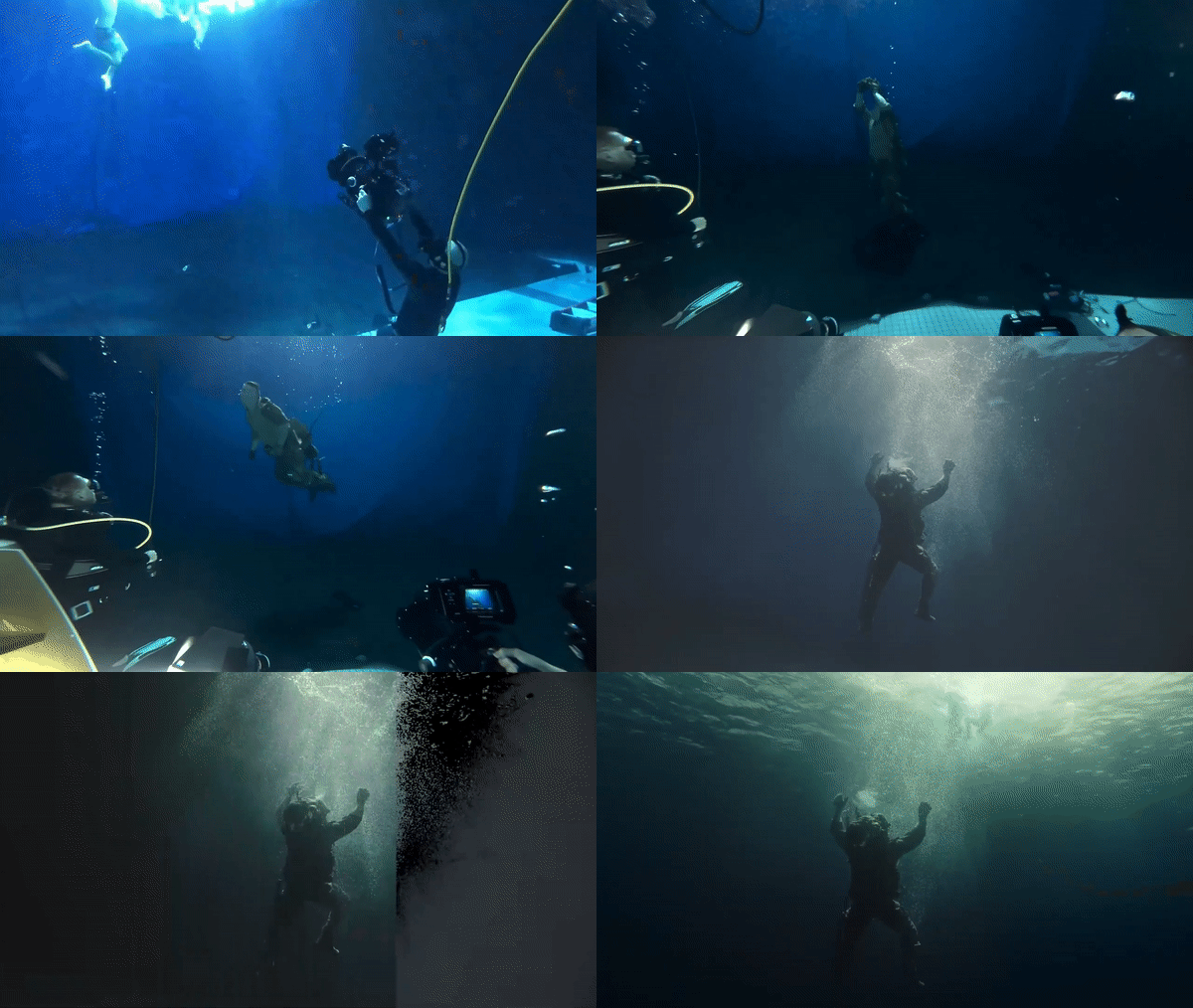
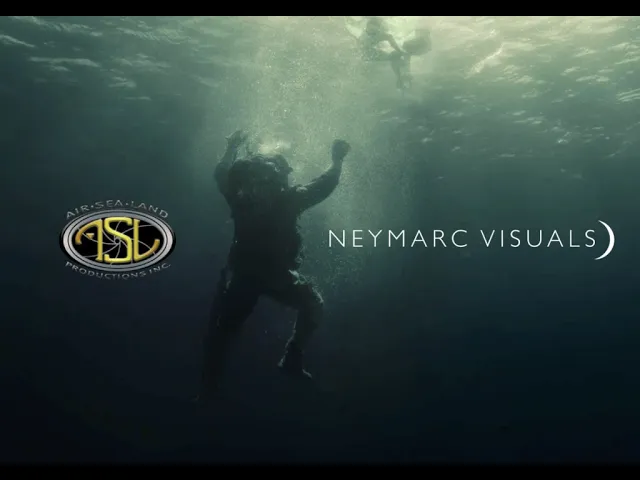
In 2022, Air Sea Land had the privilege to work on a short film called “On Duty.” Boulder Crest Foundation” commissioned by Neymarc Visuals to develop a TV commercial and brand film to raise awareness about their post-traumatic growth programs, which help veterans, law enforcement officers, and first responders overcome post-traumatic stress through growth-focused programs.

As with all underwater shoots, we planned and prepared ahead of time.

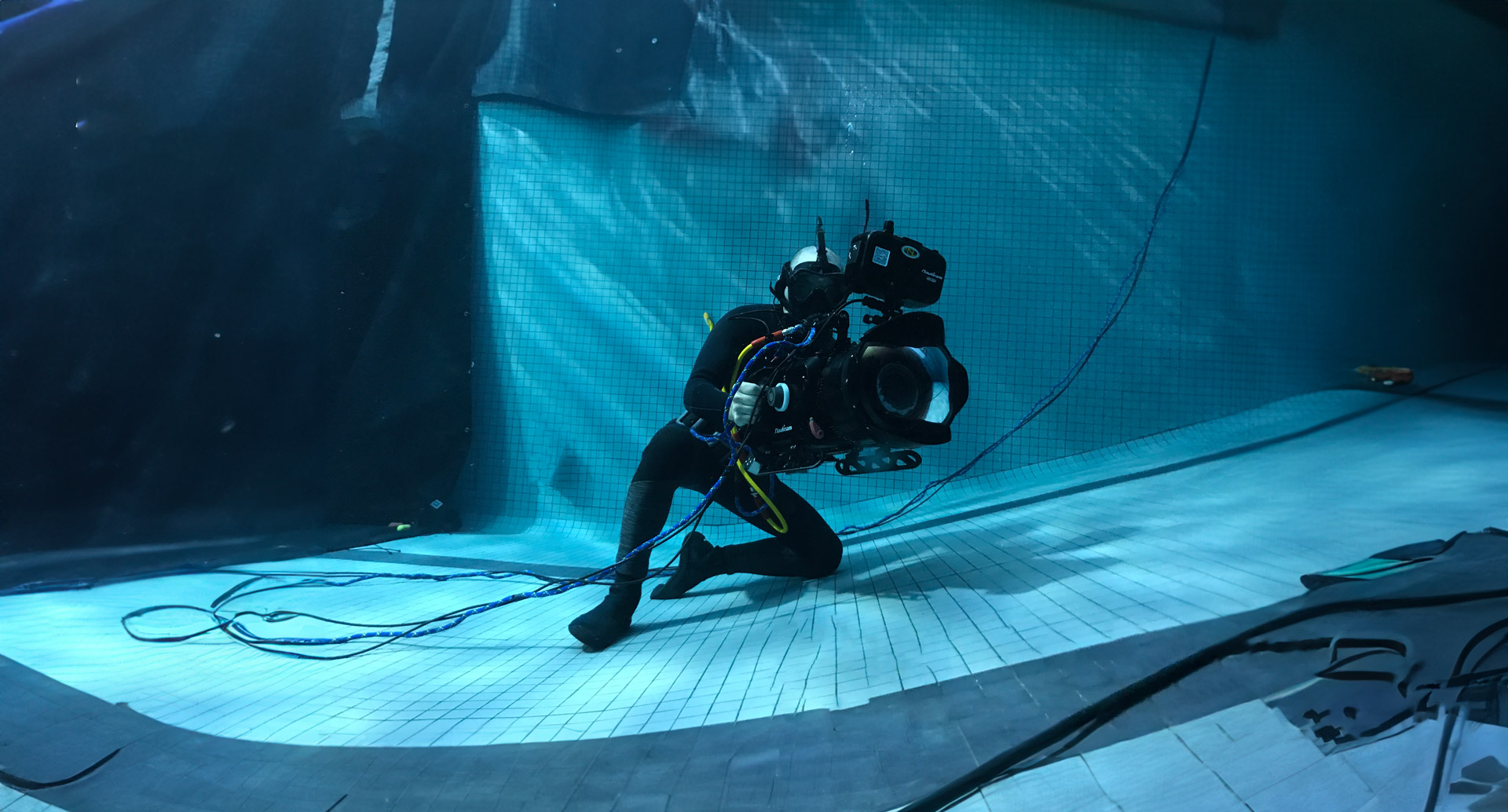
On shooting day, we held a safety meeting, blacked out the pool quickly, set up PA systems for easy communication, and lit the set. We secured a light to the end of a jib to create the illusion of a moving sun. We established a safe set for the cast and crew by organizing equipment and cables meticulously.

Production allowed us to lead, which resulted in a smooth production process, finishing ahead of schedule, a happy director, and wonderful final results.


Charting New Depths

Safety Precautions And Key Considerations When Shooting Underwater5Prioritizing safety in the world of underwater shooting is paramount. Trusting in experts guarantees smooth, well-executed productions and creates a secure environment for all involved.


With over 30 years of experience, Air Sea Land offers efficiency, expertise, and specialized equipment, ensuring a confident navigation through the depths. If you need an expert for your next underwater project, we can help you overcome hurdles and ensure the success and safety of your production.

If you want to learn more about the common challenges that underwater operators face and best practices to be aware of, check out our article “Shooting Underwater: What To Know Before You Dive In.”

Don’t hesitate to reach out to us for professional services or further assistance!


Capturing The Depths: Why Hire A Pro

Imagine captivating scenes that unlock the secrets of underwater artistry, capturing mesmerizing underwater footage, and leaving viewers breathless. Whether you’re producing a documentary, shooting a commercial, or working on a creative project, nothing compares to an experienced professional underwater videographer.


Underwater videography is a specialized skill that requires technical knowledge of state-of-the-art equipment, a strong understanding of underwater safety protocols, and the creative touch that will make your project shine. Their experienced eye for composition and storytelling will turn your footage into a visual masterpiece that resonates with viewers and leaves a lasting impression.


Experienced professional underwater videographers are not only equipped with cutting-edge underwater equipment, but they also understand the intricacies of these devices and can optimize their settings to achieve exceptional results. Moreover, their experience allows them to troubleshoot any equipment-related issues promptly, ensuring your shoot runs smoothly.


So, take the plunge and let the pros guide you to extraordinary depths beneath the surface.


About

From concept to completion, Air Sea Land is the largest production and rental house for Professional Underwater camera gear and Jimmy Jib rentals in the North East, US.

Learn more:

To begin your Rental Process

Learn more about our rental options and professional camera services

View Rental Process and Documents

Tel: 718-626-2646

Insurance

Insure My Equipment is your online portal for production equipment insurance. Instantly and securely purchase policies to cover rented equipment.